Harnessing Visual Power: Your Guide to Rural Electrification Brochure Templates
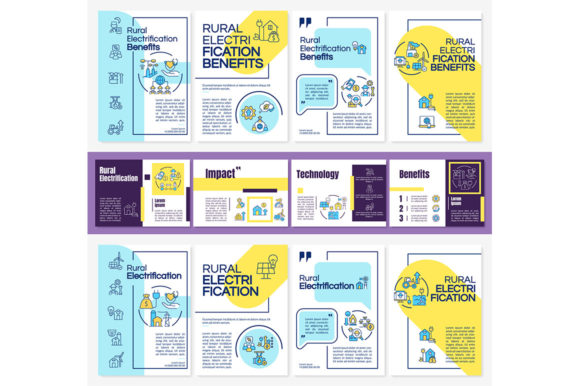
If you're tasked with communicating a complex, vital initiative like bringing electricity to underserved communities, your presentation materials need to be as impactful as the project itself. A specialized Rural Electrification Brochure Template isn't just a decorative layout; it's a foundational tool designed to convey progress, data, and purpose with clarity and authority. These templates, often featuring clean booklet print designs and thematic linear icons, provide a ready-made structure for your annual reports, community presentations, funding proposals, and awareness campaigns. Their value lies in allowing you to focus on your message, not on wrestling with design software from scratch.
Common Pitfalls in Choosing and Using Template Sets
Many professionals, from NGO coordinators to engineering firm marketers, gravitate towards these templates for efficiency. However, rushing the selection process or misunderstanding the application can undermine your entire communication effort.
A frequent oversight is ignoring the intended file formats. A template set advertised with formats like EPS, SVG, AI, PNG, and JPEG isn't offering redundancy; each format serves a distinct purpose. For instance, selecting a PNG file for a large-scale printed booklet because it was the easiest to download will result in pixelated, low-quality output. The vector formats (EPS, SVG, AI) are essential for professional, scalable print work. They allow you to resize elements without loss of quality and are editable in design applications. Before downloading, ensure you have access to software that can handle the core vector files, or confirm that the included JPEG/PNG versions are high-resolution enough for your specific print run.
The Font Trap: Compatibility and Licensing
Noticing that a Rural Electrification Brochure Template uses specific fonts like Questrial-Regular, Anton-Regular, and Lato-Regular is good, but assuming they are bundled or automatically replaced is a mistake. Often, these fonts are referenced in the design. If you don't own licenses for these fonts or have them installed on your system, your software may substitute them with default fonts, drastically altering the template's professional typography hierarchy. Always check the template's documentation or description for font inclusion. If the fonts aren't provided, you may need to purchase them separately or, crucially, confirm that the template's editable text layers allow you to safely change fonts without disrupting the layout.
Beyond the Cover: Evaluating Usability and Flexibility
Another misunderstood aspect is viewing the template as merely a front cover. A robust brochure template set for rural electrification should include coordinated interior page layouts for spreads, infographic modules, data visualization spaces, and icon sets. If you only use the striking cover and then create disjointed interior pages, your booklet will feel incoherent. Scrutinize what the "set" truly includes. Does it provide vector layouts for presentation slides that match the brochure aesthetic? Are the linear icons supplied as a separate, editable collection so you can customize them for different sections—like using a distinct icon for solar power versus grid extension?
A related error is forcing the template to fit a message it wasn't designed for. These thematic templates use icons and visual metaphors (power lines, solar panels, households) that resonate with the topic. If you attempt to heavily repurpose it for a completely unrelated industry, the dissonance will confuse your audience. The advice is to leverage its specialization. Use the provided infographic templates to clearly show pre- and post-electrification statistics, or employ the icon set to create a clear map of project phases.
The Download and Customization Process
Upon purchase or download, the immediate impulse is to open the file and start typing. This leads to the frustration of locked elements or confusing layer structures. A better approach is to first explore the file structure in your design program. Grouped layers, non-editable background art, and linked images need to be understood. Take ten minutes to identify what is easily changeable (text layers, certain color blocks) and what requires more advanced skill (editing complex vector paths). This prevents accidentally corrupting the template's core design. If the set includes an AI (Adobe Illustrator) file, remember that its full power is accessible in Illustrator; attempting to edit it in a simpler program will likely not work.
Making an Informed Decision Before Commitment
To avoid these pitfalls, your evaluation checklist should be practical. First, match the template's output to your final medium. If you need a tri-fold brochure for a community fair, a booklet template for a bound annual report won't suit your format. Second, verify the software compatibility. An EPS file is widely compatible, but an AI file requires Adobe Illustrator. Third, assess the scope of included assets. Look for mentions of "mobile app screen pages" or "ads" if your campaign is multi-channel—this indicates the designer thought about extended applications. Finally, consider the source. Providers like BSD Studio that offer new topics and discounts weekly suggest an ongoing design expertise. Subscribing for updates can be wise, but only if their style and quality consistently meet your project's standard.
Remember, a template is a starting point, not an autopilot. The most effective use of a Rural Electrification Brochure Template comes from respecting its structure while skillfully injecting your unique data, stories, and project specifics. It bridges the gap between needing professional design and having infinite design time. By choosing thoughtfully, understanding the technical details, and customizing with care, you create materials that do justice to the important work of rural electrification, ensuring your communication is as powerful and clear as the electricity you're working to bring.