Using a Climate Change Brochure Template Set for Strategic Communication
When the goal is to communicate complex, urgent information, your tools must be as precise as your message. A Climate Change Brochure Template Set is far more than a collection of graphics; it is a structured visual system designed to translate data, policy, and science into accessible, compelling narratives. For professionals, educators, and organizations, employing such a template set is a strategic decision that directly influences audience engagement, comprehension, and action.
Beyond Basic Design: The Strategic Utility of Pre-Designed Layouts
Why would a marketer, a non-profit coordinator, or a corporate sustainability officer choose a pre-defined set of templates? The answer lies in the allocation of resources. Crafting a visually coherent brochure from scratch demands significant time in conceptual design, icon creation, and layout engineering—tasks that distract from the core mission of content development and message refinement. A professional Climate Change Brochure Template Set provides a ready-made visual framework.
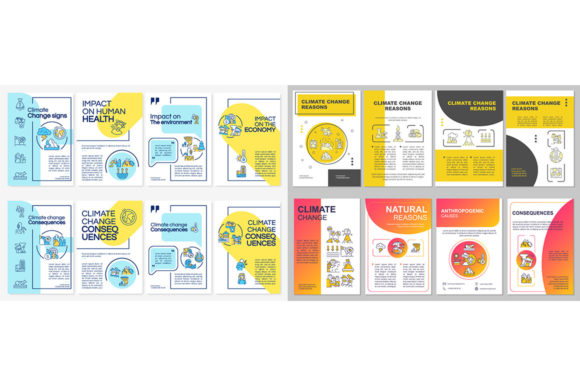
This framework, utilizing fonts like Arial Black for headlines and Lato-Regular for body text, establishes immediate typographic hierarchy and credibility. The included linear icons and vector layouts serve as a consistent visual language, allowing you to focus your energy on what matters most: curating accurate information, crafting persuasive arguments, and tailoring the narrative to your specific audience. The strategic utility is not in replacing your expertise, but in augmenting your capacity to execute with speed and polish.
Aligning Template Use with Clear Communication Goals
Intentional use begins with a question: what is this brochure meant to achieve? Is its primary goal to educate a community about local impacts, to report on an organization’s annual sustainability metrics, or to advocate for a specific policy change? Each goal dictates a different approach to the template.
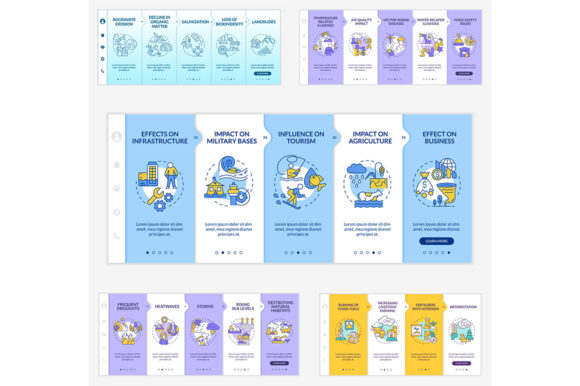
For an educational pamphlet, you might leverage the infographic templates and mobile app screen layouts to break down complex processes like carbon sequestration. For an annual report, the formal vector layouts for presentation become critical, providing a structured, professional backdrop for data and milestones. A campaign ad might use the more striking EPS or SVG iconography to create memorable, bold visuals. The template set offers versatility, but your strategic intent determines its application.
Practical Applications: From Planning to Execution
Consider a freelance consultant preparing a client proposal for a green initiative. Starting with a blank canvas adds uncertainty and delays. Starting with a Climate Change Brochure Template Set—where the color palettes, icon styles, and section layouts are already harmonized—allows the consultant to immediately populate the framework with client-specific data, case studies, and projected outcomes. This accelerates productivity and ensures the final product looks professionally branded from the first draft.
Similarly, a small business owner launching a sustainability program can use these templates to create internal training materials and external customer-facing communications. Using the same set of PNG and JPEG backgrounds, icons, and fonts across all materials creates a unified brand experience that reinforces the company’s commitment. This operational consistency saves time and strengthens message coherence.
Key Considerations Before Deployment
While the advantages are clear, thoughtful adoption requires a few strategic checks. First, assess the compatibility of the template’s visual tone with your audience. The linear icons and modern layouts in this collection convey clarity and data-driven precision, which may be perfect for a technical audience but might need adaptation for a younger, more visually dynamic demographic.
Second, understand the file formats. Access to EPS, AI, and SVG files means you have editable vector graphics, allowing for customization of colors and scales without quality loss. This is essential for true brand alignment. If you only use the provided PNGs, you lock yourself into the preset designs, which may limit long-term flexibility. Your choice of format should match your planned level of customization and future reuse.
Finally, consider content readiness. A template accelerates design, not research. The risk lies in using a polished Climate Change Brochure Template Set to deliver vague, unverified, or poorly structured content. The template’s professionalism can inadvertently lend credibility to weak substance, damaging trust. Always ensure your facts, narratives, and calls to action are robust before applying the visual polish.
Planning for Long-Term Value and Iterative Use
A strategic view sees the template set not as a one-off tool, but as a foundational asset. The inclusion of brochure infographic templates and mobile app screen pages suggests a system designed for multi-channel communication. You can plan a campaign where core icons and data visualizations appear consistently across a printed brochure, a social media post (derived from PNG exports), and a presentation slide (using the vector layouts). This iterative use builds recognizable visual patterns that enhance learning and retention for your audience.
Furthermore, subscribing to sources like BSD Studio for new topics and discounts, as mentioned with this collection, becomes part of a content strategy. It allows you to refresh your materials periodically with updated visuals and themes, keeping your communications current without overhauling your entire design system. This is a practical approach to maintaining relevance and engagement over time.
The Risks of Uncontextualized Use
Without clear goals, a template set can lead to generic, ineffective outputs. Simply filling in the blanks with any available text creates a brochure that looks professional but speaks to no one in particular. It may lack a compelling narrative arc, a defined audience persona, or a strategic call to action. The result is a beautifully designed piece that fails to inform, persuade, or mobilize. The template facilitates communication; it does not generate the communication strategy itself.
Another risk is over-reliance, which can stifle creativity. While the layouts provide excellent structure, your unique message may sometimes require a unique visual expression. The most strategic practitioners use the templates as a reliable starting point and a consistency anchor, but they remain willing to customize elements or break from the provided grid when the message demands it, using the editable AI and EPS files to do so.
Making Intentional Decisions for Better Outcomes
The ultimate value of a Climate Change Brochure Template Set is measured by the outcomes it helps you achieve. Did the brochure increase attendance at your community workshop? Did the annual report layout enhance stakeholder confidence in your sustainability data? Did the cohesive icon set across your ads improve campaign recognition metrics?
To use it intentionally, start by defining these success metrics. Then, map the template’s components to your plan. Assign the bold Arial Black headlines to your key takeaways. Use the Questrial font for readable body text that explains nuances. Employ the linear icons to visually summarize sections, aiding skimming and comprehension. This deliberate mapping ensures every element of the template serves a purpose in your communication strategy.
In essence, this template set is a strategic partner in the vital work of climate communication. It removes arbitrary design hurdles, provides a credible visual foundation, and enables you to focus your expertise where it has the greatest impact: on the content, the audience, and the change you seek to create. By approaching it with clear goals, contextual awareness, and a willingness to adapt, you transform a set of graphics into a powerful tool for education, reporting, and advocacy.