Ruminate: Evaluating a Creative Presentation Template for Modern Professionals
In the world of professional communication, a presentation is more than just slides; it is the vehicle for your ideas, your brand, and your credibility. Selecting the right template is a foundational decision that influences not only the aesthetics but the effectiveness of your message. Creative Presentation - Ruminate enters this space as a designed PowerPoint template promising flexibility and a polished aesthetic. Understanding its distinct characteristics, practical strengths, and inherent tradeoffs is crucial for anyone considering it for a critical project.
What Distinguishes the Ruminate Creative Presentation Template
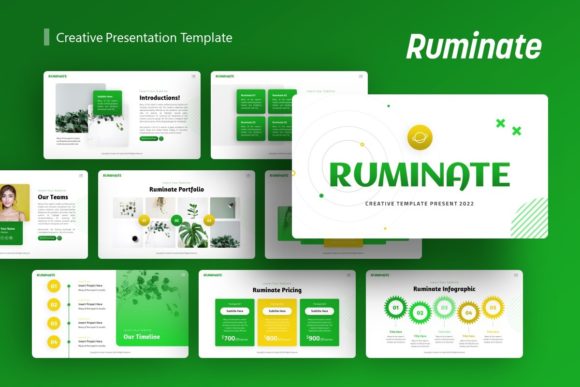
Creative Presentation - Ruminate is positioned as a multipurpose PowerPoint (.PPTX) template suite. Its core offering is a set of 36 master slides, built with handcrafted infographics and pixel-perfect illustrations. The design philosophy appears to lean towards a clean, contemporary visual style suitable for a spectrum of uses—from corporate business profiles to personal photography portfolios. A key technical feature is its foundation on master slides within PowerPoint, which theoretically allows for consistent formatting changes across the entire deck. The claim of "easy customizable contents" and editable, resizable graphics suggests it is aimed at users who possess intermediate PowerPoint skills, seeking to avoid designing from a blank canvas.
What makes it distinct from many generic templates is its explicit focus on being a starting framework rather than a rigid, single-use product. The inclusion of vector icons and dedicated picture placeholders for drag-and-drop functionality speaks to a practical understanding of user needs: the desire for professional-level design elements without the need for external graphic software. However, it is important to note the clarification provided: the demo images are for preview only and are not included in the actual files. This means users must supply their own photography and imagery, which is a standard practice for such templates but a critical point for evaluation.
Comparative Considerations: Template Styles and User Fit
When evaluating Ruminate against the broader landscape of presentation resources, it falls into the category of premium, pre-designed template packs. Alternatives range from free templates offered by PowerPoint itself or online repositories, to highly specialized templates for specific industries (like complex financial models), to entirely different formats such as Canva decks or bespoke designs created in Adobe Illustrator.
The strength of Creative Presentation - Ruminate lies in its balance of structure and customization. For a user who needs a coherent, visually unified deck for a pitch, startup launch, or agency profile, and who values time efficiency, a template like this can be a significant asset. Its handcrafted infographics could save hours compared to building similar charts from default PowerPoint shapes. Comparatively, free templates often lack this level of integrated graphic detail and may not be built on a robust master slide system, leading to formatting inconsistencies when edits are made.
A potential tradeoff, however, is originality. While customizable, starting from a pre-defined template means your presentation will share a foundational visual DNA with others who use the same product. For a company seeking a utterly unique brand expression in every detail, this might be a limitation. In such cases, a custom-designed presentation or a more modular approach using individual graphic assets might be a better fit. Furthermore, the "easy customizable" claim is relative; a user with minimal PowerPoint proficiency might still find modifying master slides or complex illustrations challenging, whereas a simpler, text-focused template might be more approachable.
Practical Applications and Best-Fit Scenarios
The listed use cases—Creative Agency, Company Profile, Portfolio, Pitch Deck—are instructive. Creative Presentation - Ruminate seems particularly well-suited for scenarios where visual appeal and structural clarity are paramount, and the content is dynamic. For instance:
- A freelance photographer could use the template to create a portfolio presentation for client meetings, leveraging the clean layouts and picture placeholders to showcase work efficiently.
- A startup founder needing a pitch deck for investors might benefit from the pre-designed infographics to explain their business model or growth metrics, ensuring data is presented professionally without diverting focus from content creation.
In these examples, the user’s primary goal is effective communication of substantive content (images, data, plans) within a professionally designed container. The template acts as that container, reducing the cognitive load of design decisions.
Evaluating Strengths and Decision Factors
A critical strength of the Ruminate template is its attempt to provide a complete system. The 36 slides offer variety—likely covering title slides, content layouts, team pages, data charts, and concluding slides—which can prevent a presentation from feeling repetitive. The inclusion of documentation is another practical strength, as it can guide users through customization steps and explain the master slide structure, potentially mitigating the learning curve.
Decision factors for a potential user should include:
- Skill Level: Are you comfortable navigating PowerPoint’s master slide and formatting tools? The template’s full value is unlocked with some technical confidence.
- Project Scope: Is this for a one-time event or an ongoing corporate template that will be reused and adapted by multiple team members? The master slide basis is advantageous for consistency across team-generated decks.
- Visual Needs: Does your content rely heavily on custom imagery, data visualization, and a balanced aesthetic? The resizable illustrations and infographics cater to this.
- Time vs. Originality: How do you weigh the time saved against the degree of design uniqueness required? This is the fundamental tradeoff.
When Ruminate May Not Be the Optimal Choice
Despite its versatility, Creative Presentation - Ruminate may not be the right choice in certain situations. If your presentation requires highly technical, industry-specific diagramming (e.g., detailed engineering schematics or legal process flows), the generalized infographics may not suffice, and a more specialized template or custom creation would be necessary. Similarly, if your entire workflow is based on a different platform like Google Slides or Keynote, a PowerPoint-specific template is inherently incompatible.
Furthermore, for users whose presentations are predominantly text-based narrative—like a lengthy academic lecture or a internal policy review—a template with such a strong visual graphic component might feel superfluous or even distracting. In those cases, a simpler, more typography-focused template would allow the text content to remain the undisputed center of attention.
Making an Informed Selection
The choice to use a template like Creative Presentation - Ruminate is ultimately a strategic one about resource allocation. It represents an investment of money (in purchasing the template) and time (in learning and customizing it) to save a greater amount of time and design effort later. For the professional or business that regularly creates presentations and views them as a key touchpoint with clients, investors, or the public, such an investment can be justified.
The most informed approach is to align the template’s advertised features with your documented needs. Scrutinize the demo previews against your actual content. Ask yourself if the layout styles would logically frame your information. Consider whether your team has the skill to maintain the template’s integrity over time. By focusing on these practical comparisons—between your requirements and the template’s capabilities, and between this option and the broader categories of tools available—you can determine if Creative Presentation - Ruminate is a helpful resource that fits your context, or if your search for the right presentation solution needs to continue elsewhere.