Evaluating Export and Import Business Concept Icons for Your Visual Projects
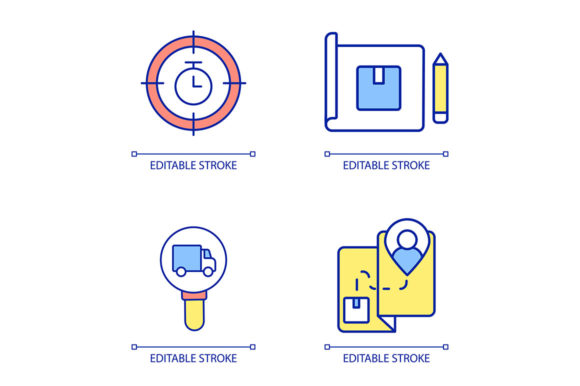
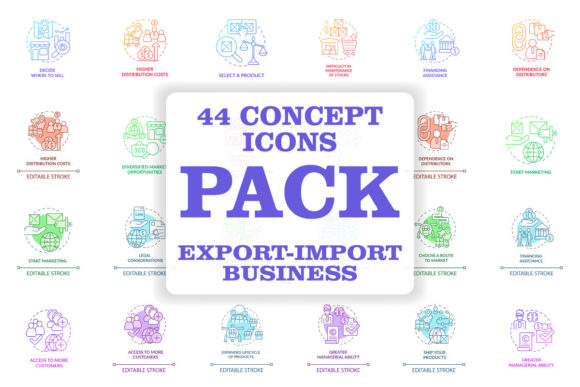
The visual representation of complex business ideas is a cornerstone of modern communication, especially in international trade. For entrepreneurs, educators, and content creators, finding the right graphic assets to explain export and import processes is a common challenge. A specific resource often considered in this search is the Export and Import Business Concept Icons bundle. This collection, described as a set of entrepreneurship idea thin line color illustrations with isolated outline drawings and editable stroke, offers a targeted solution. Understanding its distinct characteristics, how it compares to broader alternatives, and where it fits best can help you decide if it aligns with your project’s needs.
What Distinguishes This Icon Collection
The Export and Import Business Concept Icons bundle is not a general business icon pack. Its focus is narrow and thematic, concentrating specifically on the imagery associated with global trade logistics. This includes icons representing concepts like shipping containers, cargo ships, international documents, currency exchange, tariffs, and supply chains. The stylistic choice of thin line color illustrations with editable strokes is significant. It provides a clean, modern aesthetic that is versatile for both digital and print media, allowing designers to adjust colors and line weights to match existing brand guidelines. The use of fonts like Roboto-Medium and Myriad Pro-Bold in its promotional materials suggests a design ethos geared towards contemporary, professional applications.
A key practical feature is the range of product file formats included: EPS, SVG, PNG, JPEG, and AI. This multi-format approach addresses different user requirements. SVG and EPS files are crucial for scalable vector work and professional print design, while PNG and JPEG files offer immediate usability for web designers or PowerPoint presentations. The inclusion of an AI (Adobe Illustrator) file speaks directly to users within a specific professional toolset, offering deep editing capability. This bundle is part of a larger offering from a studio that also creates brochure infographic templates and mobile app screen pages, indicating it is designed to integrate into comprehensive visual systems.
Comparing Scope and Alternatives
When evaluating the Export and Import Business Concept Icons, it’s helpful to consider the spectrum of available options. Your choice largely depends on the scope of your project and your need for thematic specificity.
Highly Specific Bundles versus General Business Libraries
The primary tradeoff here is between depth and breadth. This icon bundle offers depth in one niche: export and import. If your project—such as a training module for logistics staff, a website for a customs brokerage, or an infographic on trade agreements—solely revolves around this topic, this focused collection could provide all the necessary imagery without excess. You get dedicated icons for nuanced concepts that might be absent or overly generic in a broader pack.
Conversely, if you are designing a general business plan, a startup’s overall branding, or a platform covering multiple business functions, a comprehensive general business icon library might be a more practical choice. While it may contain some trade-related icons, its strength is covering marketing, finance, HR, and operations all in one. The limitation of the Export and Import Business Concept Icons bundle is clear: it is not designed for those broader needs. Using it for a project outside its niche would require supplementing it with other assets, increasing cost and complexity.
Stylistic Comparisons: Thin Line versus Other Visual Approaches
The thin line, outline drawing style is a distinct aesthetic decision. It compares against other popular styles like flat filled icons, isometric 3D icons, or hand-drawn sketch icons. Thin line icons often convey a sense of precision, clarity, and modernity. They integrate well into sleek interface designs, formal reports, and technical documentation. Their editable stroke is a strong functional benefit, allowing adaptation.
However, this style may not be the best fit for every audience or medium. Projects targeting young children or requiring a more playful, emotional tone might benefit from filled, colorful icons. Marketing materials aiming for bold visual impact might prefer isometric or richly shaded graphics. The tradeoff is between elegant simplicity and visual density. The Export and Import Business Concept Icons, locked into this specific thin-line style, would be a mismatch for projects demanding a different visual voice.
Decision Factors and Best-Fit Situations
Choosing the right visual assets involves weighing several practical factors beyond just aesthetics.
Technical Requirements and Software Compatibility
The provided file formats are a major decision point. If your workflow is heavily based on Adobe Illustrator, the presence of native AI files is a strong advantage. For web developers working with React or Vue, the SVG format is essential for scalable, performance-friendly graphics. The bundle’s multi-format offering reduces friction for diverse teams. However, if your work is confined to a tool like Canva or basic PowerPoint, you might primarily use the PNG/JPEG files and never leverage the editable vector formats. In that case, a simpler, cheaper PNG-only pack from a different source could suffice. Evaluating your team’s actual software use is critical.
Integration with Existing Design Systems
The Export and Import Business Concept Icons are isolated outline drawings. This means they are designed to be placed into layouts without complex backgrounds, which is ideal for infographics, slides, and UI screens. Their effectiveness depends on how well their line weight, color palette, and artistic detail align with your existing brand identity or design system. Because the strokes are editable, there is room for adjustment, which is a significant strength compared to static raster images. A best-fit situation is a project where you have a established modern, professional brand and need to extend it into a trade-specific communication piece. A less ideal situation would be trying to force these clean line icons into a grunge or vintage-themed historical project.
When to Choose This Bundle and When to Look Elsewhere
Making an informed decision means matching the resource’s profile to your scenario.
The Export and Import Business Concept Icons bundle is likely the right choice when you have a clearly defined project centered on international trade education, explanation, or promotion. Realistic examples include: creating a step-by-step infographic for new exporters, designing the interface for a trade compliance software dashboard, or developing a slide deck for a university course on global supply chains. In these cases, the thematic focus saves you time searching for or clumsily adapting unrelated icons. The editable nature allows your design team to maintain visual consistency.
You may need another option, however, in several common situations. If your project covers business concepts holistically, a generalist bundle is more economical. If your required style is drastically different—needing photorealistic imagery, bold cartoon graphics, or black-and-white glyphs—this specific thin line set will not satisfy that need, regardless of its thematic relevance. Furthermore, if your budget is limited and you only need two or three specific icons (like a simple ship and a document), you might find those individually on stock icon sites, avoiding the cost of a full niche bundle.
The studio’s practice of offering new topics and discounts every week and encouraging subscriptions is a common model. For a user who regularly produces content across different business niches, such a subscription might provide ongoing value, offering this export-import bundle along with packs on finance, technology, or healthcare. For a user with a one-off, single-theme project, a direct purchase of this specific bundle is the more targeted approach.
The Role of Quality and Cohesion in Professional Design
Ultimately, resources like the Export and Import Business Concept Icons bundle are evaluated not just as individual graphics, but as a cohesive system. The consistency of style across all icons in a set—the uniform line work, the balanced level of detail, the harmonious color palette—is a hidden benefit that speeds up design work and elevates the final product’s professionalism. A haphazard collection of icons gathered from disparate sources often results in a visually jarring experience for the end-user, undermining the communication goal.
This bundle offers that internal cohesion within its niche. The tradeoff is accepting its narrow scope. Your decision hinges on whether your project’s scope matches that niche. For a designer explaining the intricacies of customs declaration forms, an icon from this set will likely be more precise and authoritative than a generic “document” icon from a broader collection. For a startup building a general e-commerce platform, however, the intricacies of export tariffs might be irrelevant, and the broader collection would serve better.
By considering the thematic focus, stylistic approach, file format utility, and integration capabilities, you can move beyond a simple “good or bad” assessment. You can determine if the Export and Import Business Concept Icons bundle is a fitting component for your visual toolkit, or if your research should steer you towards a more generalized or stylistically different alternative. This balanced evaluation leads to more efficient resource allocation and a more effective final design.