Navigating Healing: The Role of the Coping with PTSD Mobile App Screen Set in Modern Design
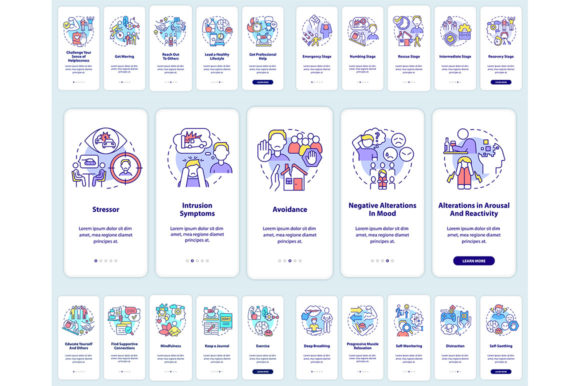
In the evolving landscape of digital health and wellness, the tools we create must not only be functional but also empathetic and intuitive. The Coping with PTSD Mobile App Screen Set represents a significant step in this direction. It is a comprehensive UI/UX template collection specifically crafted for applications aimed at supporting individuals managing Post-Traumatic Stress Disorder. This set provides designers and developers with a foundational visual language, including onboarding screens, walkthrough steps, graphic instruction pages, and linear concept flows, all designed with clarity and sensitivity at their core.
Utilizing fonts like Myriad Pro-Bold and Regular for clear hierarchy and readability, and delivered in versatile file formats such as EPS, SVG, PNG, JPEG, and AI, this collection is more than just a set of graphics. It is a ready-to-implement framework that accelerates the creation of apps dedicated to mental health support, ensuring that the interface itself becomes a part of the therapeutic journey rather than an obstacle.
The Intersection of Design, Technology, and Mental Health Awareness
The relevance of the Coping with PTSD Mobile App Screen Set is deeply tied to broader trends across multiple industries. In the health-tech sector, there is a decisive shift towards accessible, on-demand mental health resources. Simultaneously, in the creative and UI/UX design community, there is an increasing emphasis on ethical design—design that considers the user's emotional state and psychological safety. This template set sits precisely at this intersection, offering a professional solution that aligns with both technological advancement and societal need.
From a business and market perspective, the demand for specialized digital wellness tools is growing. Entrepreneurs, freelancers, and studios like BSD Studio are responding by creating focused assets that serve niche yet critical areas. The offering of such a set, accompanied by new topics and weekly discounts via subscription, reflects a contemporary business model: providing tailored, high-quality creative resources that empower other professionals to build meaningful products efficiently.
Why This Focused Design Resource Captures Attention
Professionals are paying attention to resources like the Coping with PTSD Mobile App Screen Set for several key reasons. First, it addresses a specific, complex user experience challenge. Designing for PTSD support requires an understanding of triggers, anxiety reduction, and the promotion of安全感. A generic app template would fail. This set provides a considered starting point, with linear concepts and step-by-step graphic instructions that can help users feel guided and in control, which is paramount in mental health applications.
Second, it embodies the trend towards design systems over isolated screens. By providing a cohesive set—from onboarding to core functionality screens—it ensures a consistent user journey. This consistency reduces cognitive load for the end-user, which is a critical UX principle for any app, but especially one dealing with mental health. For the creator using this set, it streamlines the workflow, allowing them to focus on customization and functionality rather than basic UI structure.
Changing Expectations and the Push for Contextual Relevance
The needs and expectations of both end-users and creators have shifted dramatically. Users now expect digital wellness tools to be not just informative, but engaging, supportive, and beautifully integrated into their daily lives. They prefer apps that feel calm, trustworthy, and unambiguous. The walkthrough steps and clear graphical instructions featured in this screen set directly meet these preferences, moving away from text-heavy, intimidating interfaces.
For designers, developers, and marketers, there is an expectation for efficiency and specialization. The market no longer rewards generic solutions. A freelancer building a mental health app for a client needs assets that are contextually relevant and credible. Using a purpose-built template like the Coping with PTSD Mobile App Screen Set adds immediate depth and appropriateness to the project. It also connects the project to larger developments in design, such as the use of scalable vector graphics (SVG) for flexibility and the inclusion of AI files for deep customization within professional workflows.
Practical Applications and Observational Insights
Consider a practical scenario: a therapist or a small startup wants to develop a companion app for their clients. Without a dedicated design team, the UI/UX phase can be a bottleneck. By subscribing to a service like BSD Studio and utilizing this specific screen set, they gain a professional GUI template that already considers crucial aspects. The onboarding screens can be tailored to gently introduce the app's purpose, the linear walkthrough can guide a user through their first coping exercise, and the icon set can provide intuitive symbols for various therapeutic activities.
Another observation is the importance of typography in such applications. The use of Myriad Pro, with its clean and modern yet warm characteristics, in both Bold and Regular weights, aids in creating a visual tone that is authoritative yet approachable. This subtle detail is often what separates a usable app from a truly helpful one. Furthermore, the provision of files in multiple formats (EPS, SVG, PNG, JPEG, AI) speaks to the practical reality of collaborative, multi-platform development workflows between designers, developers, and product managers.
Connecting to Larger Developments in Digital Wellness
The creation and distribution of specialized assets like this are part of a larger movement towards democratizing quality design in service-oriented fields. As mental health awareness becomes more mainstream, the tools to support it must be available to a wide range of creators, not just large corporations. This screen set, and similar offerings for brochure infographic templates and other app screens, enable freelancers, entrepreneurs, and small studios to contribute meaningfully to this space.
It also reflects the technology trend of component-based design and reusable systems. By investing in such a set, a professional is effectively adopting a design language tailored for a sensitive domain, which can be scaled and adapted for future projects or iterations. This forward-looking approach ensures that the initial design investment continues to pay dividends, aligning with the efficient, agile methodologies that dominate modern tech and creative businesses.
Ultimately, the Coping with PTSD Mobile App Screen Set is more than a collection of images; it is a bridge between compassionate intent and professional execution. For the professional aiming to build an application that makes a real difference, it provides the foundational visual context to do so with confidence and speed. By subscribing to platforms like BSD Studio that curate and update these resources, creators stay aligned with both evolving design trends and the persistent, critical need for better digital mental health support. In this context, the screen set becomes not just a template, but a vital component in the larger ecosystem of healing and technological empowerment.