Concept Icons for Rural Electrification Projects
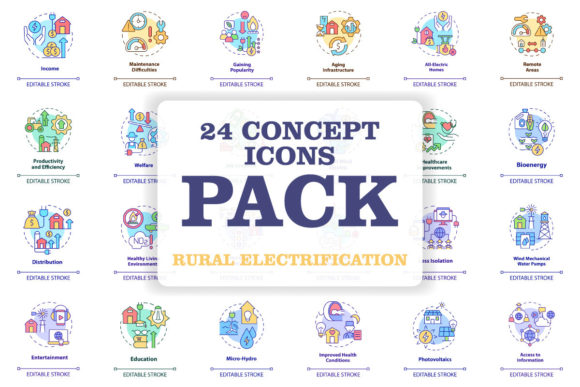
When tackling a project centered on rural electrification, communication is key. Whether you're creating a presentation for stakeholders, designing an educational website, or developing an app, you need visuals that clearly and instantly convey complex ideas like energy access, sustainable grids, and community impact. This is where a specialized Rural Electrification Concept Icons Set becomes an invaluable tool. It’s a bundle of thin-line, color illustrations designed as isolated outline drawings with editable strokes, providing a visual vocabulary specifically for this field.
The collection typically includes icons representing core concepts: a light bulb for electricity access, solar panels and wind turbines for renewable sources, transmission lines, households, and community centers. Having these elements pre-designed in cohesive styles (like EPS, SVG, PNG, JPEG, and AI formats) saves immense time and ensures visual consistency. The use of fonts like Roboto-Medium and Myriad Pro-Bold in accompanying templates speaks to a modern, clean aesthetic suitable for professional and educational materials.
Why This Topic Matters Across Different Roles
The importance of a dedicated icon set for rural electrification isn't uniform; it varies dramatically depending on who you are and what you're trying to accomplish. For a non-profit campaign manager, it's about compelling storytelling. For an engineer, it might be about diagram clarity in a technical report. This divergence in need is precisely why evaluating such a resource requires looking through multiple lenses.
For Creators and Design Professionals
Graphic designers, UI/UX specialists, and freelance creators prioritize flexibility and quality. The "editable stroke" feature in vectors (AI, EPS, SVG) is crucial here. It allows them to customize colors to match a client's brand, adjust line weights for different screen sizes, or integrate icons seamlessly into larger infographics or mobile app screens. Their evaluation hinges on the icon set's artistic coherence, scalability, and how well it complements other design elements like the mentioned brochure templates. A professional might use these icons to design a clean, intuitive interface for a solar project monitoring app, where each icon must be instantly recognizable at a small size.
For Educators, Publishers, and Bloggers
This group often balances educational value with ease of use. A university lecturer developing course materials on sustainable development needs clear, royalty-free visuals to enhance slides and handouts. The availability of PNG and JPEG formats means they can quickly drag and drop images into PowerPoint without needing advanced software. A blogger focusing on energy policy might use the icons to create simple, effective charts within articles, making data on electrification rates more engaging. Their priority is often speed and reliability—knowing the icons are professionally made and legally safe to use in publications.
For Entrepreneurs and Small Business Owners
A startup offering portable solar kits to rural communities needs to communicate its value proposition quickly. For them, the commercial value and presentation impact are paramount. They might use the icon set in investor pitch decks, website landing pages, and marketing brochures to visually articulate the problem (dark homes) and their solution (delivered solar icons). The fact that bundles often include infographic templates is a significant benefit, as it allows a small team with limited design resources to produce polished, credible marketing assets. Their decision might center on cost versus the perceived boost in professional presentation.
For Hobbyists and Beginners
Someone new to design but passionate about energy issues, perhaps volunteering for a community project, has different needs. Learning value and ease of use are top concerns. A beginner might appreciate the straightforward PNG files to create a simple flyer for a local fundraiser. They benefit from the set's cohesive theme, which guides them toward a consistent look without requiring design expertise. Their journey might start with basic use and, if the project grows, expand into learning how to use the editable SVG files for more customization, making the resource useful long-term.
Identifying If This Icon Set Matches Your Project
To determine if a Rural Electrification Concept Icons Set is right for you, consider your project's core requirements. Ask yourself a few practical questions.
What is my primary output? If it's a technical document, ensure the icons are precise and include symbols for grid infrastructure. If it's a public awareness campaign, look for icons with strong emotional resonance, like a lit bulb versus a dark one.
What software do I use? If you work in Adobe Illustrator, the native AI files are ideal. If you work mainly in web tools or Canva, confirm the SVG or PNG files are high-resolution and easily imported.
Who is my audience? Icons for a financial report need to be formal and diagrammatic. Icons for a school textbook need to be simple and colorful. The style of the set should align with this.
What is my timeline and skill level? If you need results tomorrow, a ready-made bundle with multiple formats is a lifesaver. If you are skilled and plan a long-term series of projects, the flexibility and commercial license of the vector files become the deciding factor.
Practical Examples in Action
Imagine an NGO project coordinator preparing a grant proposal. They use the household and transmission line icons to create a map infographic showing current vs. projected electrified villages, making the proposal's goals visually concrete and easier for reviewers to grasp.
Consider a freelance web developer building a site for a microgrid company. They integrate the solar panel and battery icons as featured graphics on the service pages and use the editable SVG versions to animate them subtly on hover, enhancing user engagement without extensive custom illustration work.
A high school teacher creating a lesson plan on global development might use the simple PNG icons of different energy sources in a comparison table, helping students visually categorize renewable versus non-renewable options for rural settings.
In each case, the same core set of concept icons serves a unique purpose, tailored by the user's role, priorities, and technical approach. The bundle’s value isn't just in the drawings themselves, but in how they accelerate and elevate communication across a wide spectrum of needs—from the rapid creation of a beginner's poster to the nuanced customization of a professional's interactive design.
Ultimately, resources like these, offered by studios that frequently update topics and discounts, help bridge the gap between complex subject matter and clear public understanding. They empower anyone communicating about rural electrification to do so more effectively, regardless of their starting point. Whether your priority is creative control, cost-effectiveness, or simply getting a clear message across, the right visual toolkit can make all the difference.